Showing posts with label Tales From La Cocina. Show all posts

Pan Dulce: The Curious Case of La Mujer Misteriosa

I drove home feeling more than a little annoyed at myself for wasting my precious gasoline and getting laughed out of every Mexican bakery in town. Foolish to think any panadero [baker] in his right mind would hand over to a stranger with a blog his super secret recipe for pan dulce. I got down from my car and walked up to my gate.  It was then when out of the corner of my eye I saw her step out of the shadows.

She was all ruby lips, high cheekbones and flowing dark hair. There was a pair of 5-inch heels on her feet and a peacock blue satin sheath on her curvaceous canela-colored body. It looked like she was dressed for a fiesta, but I got the feeling those lovely legs of hers had never seen the insides of a pair of jeans. I could smell her Maja perfume, she was standing so close.

She smiled with a kind of defiant confidence as if to say, ándale [go ahead], stare at me all you want, see if I care. All the while, her large eyes examined mine.

Buenas tardes, Señora Clementina, that is your name, isn’t it? There is something I would like to show you.”

Dangling in front of my face was a piece of paper. In large flowery writing was the recipe no panadero in town was willing to part with—pan dulce. A sort of sly conspiratorial grin came over her face.

“I would like you to have it, gratis.”

I smiled back, but my middle-aged bones knew this muchacha’s motives were far from altruistic.

“¿Quién eres?--Who are you?” I asked.

“Una amiga.”

“So you won't tell me your name.  Well, a-mi-ga, why are you doing this? Are you in some trouble?”

Almost immediately, her face darkened and the haughty smiling María Felix mask fell off, revealing a shiny-eyed almost tearful wistfulness. But it lasted just for a moment. By a powerful but subtle force of will, the confident cool veneer came back to her face.

“I have my reasons.  You can't expect me to tell you everything, que no?  There are secrets every woman should keep to herself.”

Ay, si.  I know what you mean." I smiled.  "We all have our secrets, but I know yours—it’s a man. Hasta lo puedo oler—I can even smell him.”

“Look,” I said as gently as I could. “No me andes con misterios—don’t get all mysterious on me, okay? You want me to put this recipe on my blog, right?”

Sí, quiero que lo mire todo el mundo—I want the whole world to see it.”

“Including el panadero you stole it from?”

“Especially el panadero I stole it from. I want to see him suffer when he sees that his precious secret recipe isn’t so secret anymore.”

Oooooo, qué castigadora—you’re a tough little torta, Señorita.” I laughed.  Only a panadero of all people would consider this the ultimate act of betrayal.

“Tell you what. Go back and make up with that panadero of yours—ó mándalo a la porra—or tell him to get lost. Forget you even knew him. It’s just not worth it.”

“I see."  Her ruby lips dropped a couple of inches. "Pues ya me voy—I’m leaving now.” Then she stopped and looked at me with the furious eyes of a tigresa [tigress]. “You know, Doña Clemen, I thought you were different. I thought you of all people would understand me, but I see you are just like every other vieja celosa—jealous old hag.”

With a sudden motion, she reared her face against mine.  For a second, I was afraid she would knock me down or push me against the gate.  Instead she crumbled the paper with the pan dulce recipe on it and threw it at my feet.

“Here! Take the recipe for all I care.”

And with that she stalked off, her 5-inch heels making tacón-tacón-tacón sounds as she headed to the curb.

Espera—wait!” I cried after her, but it was too late. I ran up just in time to see her shiny black ’59 Chevy Impala roaring past me. Its back lights grew ever smaller as I stood silently watching them before they disappeared onto Whittier Boulevard.

And that was the last I saw of her.

Who was that mujer misteriosa who walked out of the shadows that evening? I cannot say. All I know was that she was beautiful, her voice was as sultry as a hot city street after sunst—and she was out for the sweetest recipe of them all—revenge. Whoever that hombre is, whatever he did to wrong the heart of a woman like that, I have only one thing to say to you, Señor Panadero. You had it coming.

(As much as I wish there was a mystery woman standing by my gate with a secret recipe, this story is pure fiction.)


“Conchas” de Pan Dulce
Mexican Sweet Bread “Shells”


The recipe for pan dulce is no great mystery, but those of us who have always eaten them from a panadería are in for a sweet surprise. Who can resist a pan dulce when it’s hot from the oven, with its soft, yeasty just right sweetness and that incomparable crumbly, shell shaped vanilla-cinnamon or chocolate topping? Wake up early on a Sunday morning to bake them and find out why el panadero wants to keep this recipe under wraps. Most recipes call for all-purpose flour, but I love the lighter texture bread flour gives these panes dulces. Serve them the traditional way, with Mexican hot chocolate.

4 cups bread flour (or, all-purpose flour if you prefer a denser pan dulce)
2 ½ teaspoons dry active yeast
½ cup warm water
1 cup warm milk
1 teaspoon salt
1 egg, room temperature
1/3 cup butter, melted
½ - 1 teaspoon ground cinnamon

For Chocolate and Vanilla-Cinnamon Toppings:

2/3 cup sugar
¼ teaspoon ground cinnamon
½ cup butter, softened
1 cup all purpose flour
1 tablespoon powdered cocoa

In a medium bowl, stir together yeast and warm water. Add milk, ½ cup sugar, 1/3 cup melted butter, salt and eggs and mix well.

Pour the flour and cinnamon onto a large flat surface. Make a large “hole” in the middle of the flour.


Gradually pour the wet ingredients into the flour and stir together using a large fork until the dough starts to come together.


Knead the dough for 7 or 8 minutes until it is smooth and elastic. The dough should be moist and “bouncy”. Do not add too much extra flour.


Place the dough in a large greased bowl. Turn the dough to coat, then cover with a loose towel. Place the dough in a warm place (the top of a warm oven or dryer is ideal) and wait until it rises and doubles in size, about 1 hour.

Make the chocolate and vanilla-cinnamon topping: In a medium bowl, beat 2/3 cup sugar, cinnamon and ½ cup butter until fluffy. Stir in the flour and mix until it resembles a thick paste. Take half of it and set it aside. Take the other half and mix it with the powdered cocoa until well blended. Wrap the toppings in plastic and put them in the refrigerator to firm up.
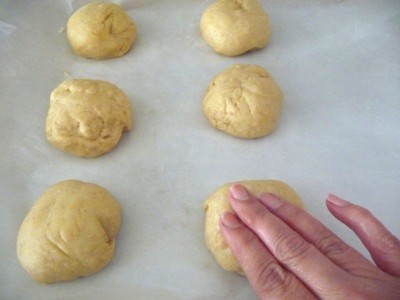
Remove dough from the oven. Cut and shape the dough into 12 - 24 balls, depending on the size you want. Line a cookie sheet with lightly greased parchment paper. Place balls on the cookie sheet and gently flatten each ball with the palm of your hand. Space balls 2 ½ - 3 inches apart.


Roll out the chocolate and vanilla toppings under plastic wrap as shown.


Take a bowl or a glass that is wider than the balls of dough to cut the topping into circles.


Use a steel spatula to gently lift each circle . . .


. . . and gently place it over each ball of dough.  Use a small sharp knife to score the toppings in a clam shell pattern or any pattern you want.

Preheat oven to 370° F. Let the balls rise for another 30 to 40 minutes. Bake for about 20 minutes or until golden brown.  When they have cooled off, you can give them a light dusting of granulated sugar (optional).

Hombre A Hombre

(Scroll down for CHAMPURRADO recipe.)

"¿Qué haces aquí—what are you doing here?" asked Francisco's father.
"Mama said you'd be here. Papá,what I said to you last night, nomás era una broma—it was just a joke. Why can't you have a sense of humor?—"
Don José averted his gaze and looked out across the strawberry fields to the emerald-hued hills. For a moment, his thoughts lingered on a certain point. Lately, a condescending note had crept into his son Francisco's voice. He was high-handed toward his hermanos y hermanas, even to his mother. He even started speaking to him as if he were un viejo simplón—a simpleminded old fool. But last night! What he said to him last night was el colmo—the last straw. Now ese hijo malagradecido—that ungrateful son of his was showing up to explain himself. It was time to speak to Francisco hombre a hombre.

"You came all this way to tell me that? Sabes, Francisco, first you show me some respeto-respect. If you really feel bad about what you said to me last night, you'll help me pull out these weeds and dead plants." He waited to see what Francisco would do, but Francisco's face registered nothing but disgust.


"In case you don't remember," he retorted, "but I've already done that. I can't believe you want me to leave everything I've learned and worked hard for only to come back here to work like a burro in this lodo." He pointed to the ground and stamped his foot, splattering mud all over. His superciliousness usually worked wonders on frightened underlings, but it had absolutely no effect on Don José. He only looked at him with a curious mixture of resentment, a touch of amusement and what can only be described as lástima—pity for a son whose greatest accomplishment at this moment was the painful realization that he was behaving like a whiny self-important twit.

Don José's let the insight sink in, then his voice grew gentle. "Did I say I wanted you to come back and work in the fields? No, mi'jo. But I taught you never to be afraid of hard work and aguante. Aguante y paciencia—endurance and patience. Sabe dónde—who knows where you learned to make fun of your father—pero de nosotros no—but you didn't learn it from us." He started laughing at the absurd situation he found himself in. After years of hard work and sacrifice for the sake of his children, his only "reward" was having a son who appreciated none of it. "Mira nomás—just look at yourself." Don José pointed to his son's muddy boots.

Francisco's face was white, then turned as red as a strawberry. He was embarrassed—no, mortified, but machismo and pride made him reply, "I'm tired of your reproaches and con—se—ji—tos—your little pieces of advice. I don't have anything more to learn from you."

"¿Deveras? You're just angry that you didn't get off easy. You thought you could pat on me on the head como tu perrito—like your little dog and be gone. Tell me, Francisco," asked Don José, whose eyes never left Francisco's face, "¿nos quebramos el lomo—did your mamá and me break our backs working in the fields to put food in your mouth so that you could insult us?"

Francisco was silent. There was a feeling of rupture in the air. The only sound was the early morning breeze as it filtered its way through eucalyptus trees at the edge of the field.
At last Don José spoke in a tone as quiet as Francisco had ever heard him speak. "Ahora con su permiso—with your permission, but this burro has work to do." He dropped to his knees and started yanking weeds and dead strawberry plants. His father had never before addressed him in the formal usted. Their conversation had come to an end.

Francisco made his way across the field. More people started arriving. Some remembered him and tried saying hola, but he ignored them. His trousers and boots were caked in mud. He tried to scrape some off before getting in his car, but they ruined. He slammed the car door and drove off.
Don José's heart felt heavy and sick, but work had made him forget Francisco as it had all his other troubles over the years. The winter sun started to peek from behind the hills, but with it, a wind from el norte started kicking up. Cold penetrated his jacket and made his bones and body ache.

"Last night he called me una papa enterrada [a buried potato], as if I don't have brains in la cabeza, as if I didn't have a corazón. Perhaps he is right. ¿Qué pasó—what happened? When he was just a muchachito he looked up to me. Now he looks down on his pobre viejo."

What was it with Francisco? Was it this country with its language and customs, the education he received, the people he hung out with, were all these turning his son into un estraño he no longer knew? Then there was la Heidi, the German girl Francisco met overseas and took as a bride. She was nice—she always smiled at him even if they couldn't understand each other. And she worked hard. There wasn't a dirty cup she didn't wash, a floor she wouldn't mop, cleaning, always cleaning, never sitting down to chat with the rest of the la familia until she left the kitchen spotless. Still, she turned red as a chile if she ate one little jalapeño. She insisted that German beer was better than Mexican, and thought nothing of joining in the conversation of men. Perhaps this was all Heidi's fault. Why couldn't Francisco have married a girl de su raza, a Mexican girl who spoke Spanish?

Later that day, when Don José felt a tap on his shoulder he was surprised to see it was Francisco. He was holding a large thermos in his hand. There were rubber boots on his feet and a sad look of self-reproach on his face.

"Papá, tiene frío—you're cold, would you like something to drink?"
Don José barely acknowledged him. "No quiero nada—I don't want any." Francisco poured some champurrado into a cup and thrust it into his father's hands. Don José looked at it reproachfully but found himself drinking all of it. It was fragrant of clavos y canela—of cloves and of sweet cinnamon spice. There was the taste of bittersweet chocolate and piloncillo—raw Mexican sugar. It coated his throat and warmed his whole body.

"¿No vas a tomar—aren't you having some?" he asked.

"Heidi made this for you. She told me to come back and apologize to you for being such a dummkopf—that's German for idiota, Papá." And, with a sheepish smile he added, "Mamá taught her how to make it."

"Vaya—did she now?" His surprise couldn't be more complete. He took another sip of the champurrado and said, "I've always like that güerita you married. Te tiene de la
cola—she has you by the tail."

Francisco allowed himself to laugh. That was not quite true, or so the thought, but he let it pass.

"Now I'm going to tell you what I should have said this morning. Lo siento, Papá—I'm sorry.
Perdóname—forgive me—."

"For what, mi'jo?" Don José shrugged his shoulders and with a dismissive wave of his hand indicated that all was forgotten. Now that Francisco offered a real apology, his father extended a real, if slightly offhanded kind of forgiveness that left both of their dignities intact.

Francisco started working another row of plants. Not another word passed between father and son. When it got too cold, each took his turn drinking the champurrado Heidi had made.
The field resembled an immense canvas striped brown and green. They and the others gathered all of the foliage into large plastic bags and left them on the side of the road that divided the field. Later, a truck would come by to haul them away.

Twilight. Soon darkness and soft rainfall. It was time to go home.


Champurrado
Many thanks to Barbara Hansen, former "Borderline" columnist for the LA Times, for allowing me to adapt her champurrado recipe. You can find Barbara at her delicious and informative
Table Conversation blog. Thank you, Barbara, for loving Mexican food and for preserving precious recipes. You taught many of us how to cook.

Ingredients:
4 cups water
1 large cinnamon stick
1 or 2 cloves
1¼ cups water
1 cup instant masa
½ to 1 whole circular spiced Mexican chocolate such as Ibarra or Abuelita; or, 1- ½ oz. semisweet chocolate plus 1 tablespoon sugar, pinch of cinnamon and 3 or 4 drops vanilla extract
1 cup firmly packed brown sugar; or one medium sized cone of pilloncillo (Mexican raw sugar)
1 (13-oz.) can evaporated milk


Combine 4 cups water, cinnamon stick an cloves in a large saucepan over medium-high heat. Bring to a boil, then remove it from the heat. Cover and let it stand for at least one hour. The water should be a deep cinnamon color. Remove the cinnamon stick and the cloves.

Gradually blend the instant masa into the 1¼ cup water until it is smooth. Strain the masa through a wire mesh sieve into the cinnamon water, or use a wire wisk to make sure that there are no lumps. Add the brown sugar or the pilloncillo, the chocolate tablet or the chocolate flavorings. Bring to a boil over medium heat, stirring constantly. When the mixture has thickened, add the evaporated milk. Cook and stir until hot. Add water or milk to thin it down if you like.

Serves 6 to 8 people.

The Battle of The Tamales

(Scroll down for Recipe for Pork or Beef Filling With Chile Colorado For Tamales, Tacos Or Tostadas)

It is a truth universally acknowledged that when a man comes into possession of a little dinero, he will go in search of a wife. Living at home with a doting mamá who coddles and spoils her mi'jo, dándole todo en la mano—serving him hand and foot—and treating him like a king is all well and good, but the instant he finds the girl of his dreams, he will say adiós to his jefecita and moustached sisters faster than you can say enchiladas and will attach himself to his amorcito, and will start raising a familia of his own.

If the girl he marries is wise, she will do well not to expect her beloved's family to accept her con brazos abiertos—with arms held wide open. She will know that, though he may revel in her many attractions, his unceremoniously dumped mamá and hermanas may be less enamored with the object of his affection.

As for Josefina, Luis's new bride, she knew nothing of the painful consequences that befall presumptuous young women who dare steal away the love of a son and a brother until it was thrust upon her quite suddenly one afternoon when she overheard a conversation that her cuñadas—sisters-in-law—were having in the kitchen.
"¿Sabes qué, Teresa?" said Maria Elena, as she rolled out the tortillas for that evening's cena. "I bet that little chiflada Luis married doesn't know how to wash her own chonis. With esas
uñotas—those long nails of hers, the only thing she can do with them is scratch herself."

Teresa laughed while she heated the tortillas on the comal. "I think that lazy perezosa can't cook, not even rice and beans. Just wait, when the honeymoon's over, "La Hollywood" and my brother will be coming over to the house to eat Mamá's food everyday. She'll sit at the table como una reina—like a queen, showing off her fancy clothes and bragging how they went dancing until la madrugada. Until dawn. Como la quiero deschongar--I'd love to yank some hair off her head! Ahorita Luis anda todo enamorado—he's all in love right now, but he'll get sick of her. You'll see."

"Oye, María Elena," she added, leaning closer to her sister and lowering her voice in case anyone might be listening, never once imaging that Josefina, who was standing just outside the doorway, was straining to hear every word she said.

"You know what Mamá says about her?" And with a ridiculous but solemn expression Teresa raised a fat finger and uttered like a sacred pronouncement one of her mother's many sayings: "'Luz de la calle, oscuridad de la casa*—'", which their mother whispered in connection with mujeres malas—"bad women" who she thought lived for lighting up the streets at night, only to come home in the early morning hours to a dirty dark house with rancid beans and cold tortillas.

Upon hearing such talk, any girl would have burst into la cocina and shaken her fist in her sister-in-laws' faces. A foolish girl would have screamed at her mother-in-law and had started una revolución. Perhaps she would have said, "Esa vieja bruja—so that old witch and her daughters think that I'm a cochina chamagosa who spends all day in front of the mirror, don't they? Ya verán. ¡Me la van a pagar! They will pay!" But not "La Hah-li-gwoood".

Instead, she slipped quietly out of the house and began to think and to think and to think.
Later that evening, Luis called his mother Leonor to invite toda la familia over to the house on Saturday. They say revenge is a dish best served cold. But Josefina knew that sometimes it is best served hot and in the form of a tamal.
It was the first time Doña Leonor and her daughters had ever been to Luis and Josefina's home. It was not un ratonero—the rat's nest they expected to find, but tidy and bright. Sitting on the table was a tub of freshly prepared masa. It was light orange from a bit of chile sauce Josefina had added to it to give it some color. Doña Leonor took a sniff and a small bite of the masa to see if it tasted sour, which means that the masa has gone bad, as she expected it would. But no such thing. It tasted fresh. The broth and chile sauce Josefina had put in to the masa were flavorful and tasted just right. But when she saw a bit of masa floating in a glass of water, it was a dead giveaway. "La Hollywood" was not so ignorant about cooking tamales as she looked.

Josefina came out of the bedroom wearing a clean white apron with little pink ruffle edging, looking as rested and fresh as if she hadn't arisen at five o'clock to start cooking. Even at this hour she looked like Dolores del Río, armed with her high heels and firmly placed red lipstick. With a hola! she greeted Doña Leonor, María Elena, Teresa and the other family tamaleras—tamal makers—who began arriving. They brought more food to eat with the tamales: rice and beans, tender nopalitos, red and green salsas, drinks and choco-flan cake. Soon the kitchen was loud with the happy chatter of women. But when it was time to work, Josefina wasted no time and started making perfectly wrapped tamales at a speed that astounded all who watched.

Her cuñas and suegra bore it all with a stubborn silence. In a sea of amistad, there they sat as gloomily and as taciturn as las momias—the mummies of Guanajuato. They made no mention of the deliciousness of the pork meat or how the fluffy masa spread on the corn husks as easily as spreading the thickest buttercream frosting on a cake. Why pay any compliment to that conceited pocha Luis married?

Josefina, on the other hand, looked as happy as could be. Her alegría only seemed to intensify in direct proportion to the ever increasing disapproving looks María Elena and Teresa threw in her direction. Still, her courage did not fail her, nor did her wide-eyed sweet expression alter one bit.

In time, after what was a whole day of cooking the pork meat and roasting the chiles, of soaking the corn husks in hot water to soften them, of beating the masa for what seemed like an eternity until it almost floated in air, then having an army of women converging on said masa and wrapping dozens upon dozens upon dozens of tamales, loading them all into two tall, large pots, and steaming them for what seemed like hours, the tamales were done.

A cocinera's reputation rises or falls flat on the strength of one tamal. But more was at stake, and Josefina knew it and so did Doña Leonor and her daughters. It was a mighty battle fought, not with guns or knives, but with masa, corn husks, puerco and chile colorado for the heart of one Luis Salazar.
The moment of truth had arrived. The unsuspecting Luis sat down at the table next to Josefina and just across from his mother. When he peeled away the corn husk from his tamal and took his first bite, he put his fork down, and looked at Josefina with a look that bespoke sheer bliss.
"Con razón me casé contigo—no wonder I married you, Josefinathese tamales are the best I've ever had en toda mi vida—in my whole life! Don't you think so, ΄Amá?"

Everybody at the party grew silent--Luis had committed the cardinal sin of disrespecting his mamá's tamales! Some began to whistle and laugh. Everyone turned to look at them, wondering if there was going to be un pleito--a fight.
"O verás, trompudo—¡ya no te voy a cocinar nada! Better watch it, you with the big mouth, I'll never cook for you again!", his mother laughingly cried out, but tiny tears began to form in her eyes. Se aguantó—she held them in because, stoic and prideful woman that she was, she never would have allowed herself to cry before anyone, certainly not at a fiesta such as this with every eye looking upon her.
Josefina could not bring herself to smirk into her mother-in-law's face. Instead she saw what Luis's off-handed remark had done to hurt his mother and painfully recalled her own role in embarrassing her, although unspokenly. Josefina then felt a pin-prick of guilt, the beginnings of regret.

"Doña Leonor," she stammered as she reached across the table to pat her mother-in-law's arm. "No le ponga atención—don't even listen to him! You know he loves your food."

In true suegra fashion, Doña Leonor made no reply, revealing nothing at least to the rest of the party. But the ever watchful Josefina did catch a glimpse of that something in her eyes that appeared and then disappeared in a freeze-frame of an instant--the shadow of a humiliated but angry defiance of someone who has been beaten at her own game.

It would be pleasant but absurd to think that all was peaceful between them, that the budding rivalry between a young woman and her suegra died that night and never sprouted again. Anyone who believes such a thing knows nothing of the passion and insecurity of a new bride or of the possessive love of a mother. However, there was one thing could be said of that noche so many long years ago: La Hollywood won the Battle of The Tamales, and never was she ever called "la oscuridad de la casa" again.
*"Light of the street, darkness of the home."

Dedicated to my friend Ester D., daughter of Josefina, one sweet little viejita who was a tamalera extraordinaria. Many thanks to my sister L-- for editing and for even contributing a few lines to this story (the best ones).


Pork or Beef Filling With Chile Colorado For Tamales, Tacos, Tortas & Tostadas
Relleno de puerco o de rez con chile colorado para los tamales, tacos, tortas & tostadas
Bless her little corazoncito, my mother-in-law usually ordered about 30 pounds of masa to make her tamales. Sometimes she would combine the shredded pork and beef, which makes for a filling that was both tender (pork) and flavorful (beef). Instead of putting a black olive in the tamal, do as she did and use a green pimento-stuffed olive. A bit of raisin and a few strips of pickled jalapeno only adds to a rollcoaster ride of flavor that goes from hot to sweet to salty in just one bite! Just omit the olives and the raisins and you have a great filling for tacos or tostadas.

To learn the ins and outs on making tamales, click here.
INGREDIENTS:
3 pounds pork butt or shoulder OR 3 pounds boneless beef shoulder
water
1 large yellow onion, cut in half
4 large garlic cloves
1 tablespoon sea salt
1/2 teaspoon ground black pepper
1/2 teaspoon dried oregano
1/2 teaspoon ground cumin
1 bay leaf
Chile Colorado Sauce (recipe to follow)
Instant Corn Flour Masa Recipe For Tamales (click here) OR Fresh Unprepared Masa Recipe (click here)
5 or 6 golden potatoes, cooked peeled and cut into small bite-sized chunks
1 large can of pickled jalapeno strips
jar of green pimento-stuffed manzanilla olives OR large can of black olives to taste
box of black raisins (optional)
two bags of corn husks for tamales
Put the pork or beef in a large cooking pot and fill with water plus 1" to 1 1/2". Bring the water to a boil, then reduce heat to medium. Remove all the scum that rises to the top. Add the salt, ground black pepper, oregano, bay leaf, cummin, garlic and onion. Cover the pot with a lid, reduce heat to let simmer for about 1--1 1/2 hours or until the meat is tender when you pierce it with a fork or knife.
Remove the meat from the pot and let it cool for a little bit. In the meantime, using a large spoon, skim as much fat as you can from the meat broth. Remove about one half of the broth from the pot for later use to make the masa, etc. Remove the cooked onion and set aside. Discard the garlic cloves.
Then, use a fork or your fingers to shred the meat. Return the shredded meat back to broth and mix well. Add the Chile sauce, the potato chunks, the olives and raisins to taste and mix thoroughly.
Taste the meat-broth mixture. Now is the time to adjust the seasonings to your taste. Does it need more salt? More black pepper? A bit of dried oregano or cummin, perhaps even a spoonful of the vinegar from the pickled jalapenos? Maybe even a teensy little bit of sugar to make it just right?
Continue to simmer uncovered until the meat filling is nice and saucy, not too thick or too thin. If it does get too thick just add a some broth.
CHILE COLORADO SAUCE RECIPE:
4 dried California chiles
4 dried New Mexico chiles
2 dried guajillo chiles
4 cloves unpeeled garlic
3 tomatoes
3 cloves
Vegetable oil
the two cooked onion halves from the meat broth
Remove the seeds and stems from all of the chiles. Next, heat the comal or griddle over high heat for a minute or so. Add a tablespoon of vegetable oil and lower the heat to medium. A few at a time, toast the dried chiles until you smell their aroma. Remove them from the heat and set aside. In the meantime, toast the garlic cloves for about 3 minutes on all sides.
When you are done toasting the chiles, add another tablespoon of vegetable oil to the comal and roast the tomatoes until their skins burst on all sides. Remove them from the comal and let them cool off for a little while and cut them into quarters. Peel the skins off the garlic cloves.
Put the tomatoes, garlic and the cooked onion in a blender and whirl them until they are smooth. Then, add the chiles to the tomato mixture and whirl on high until the tomato mixture is completly smooth. If the sauce is a little too thick, just add a bit of water or broth.
Pour the chile-tomato mixture to the meat broth mix.


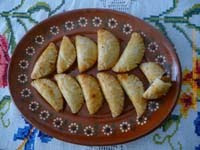
The Pumpkin Moon Empanadas is now available on Amazon.com.
(Artwork courtesy of Sarah D. Thomas)
 
 "Papi, does the moon taste like cheese?"
The little girl walked hand in hand with her father. The harvest moon hung in the fall night sky.
"Who told you that?"
"Tía Lupita told me."
"It don't taste like cheese. It tastes like pumpkin.""How do you know, Papi?"
"Because when I was little like you, your abuelito—grandpa—took me there and we tasted it." 
"For reals?"
"For reals, mijita." He tightened his grip as they walked along.
He smiled as he looked down at his little daughter and said, "One day I'm going to bring you the moon, and you and your mamá will make pumpkin moon empanadas—the best you've ever had."
A few days later, he kept his promise, for he brought home a pumpkin that looked like Cenicienta's (Cinderella's) coach. Its orange luminosity glowed against the bright green of its stem. A kind of sparkly dust clung to it.
He called after her laughing. "Mira, mi'ja. Didn't I tell you that your papito would bring you the moon?"
¿Y de dónde agarraste esto?—And where did you get this? It's too beautiful. We can't eat it," her mother objected.
"Of course we will eat it. I went through a lot of trouble to get this pumpkin, and you are going to make us some empanadas.
Apúrate—hurry up, because tonight I'm going to eat some with you and la muñeca—the little doll."
So her mother cut up the pumpkin and roasted it in a hot oven until it was soft. Then she mashed it and let it hang in a bag of cloth until all the moisture was drained off. Her mother added cinnamon and spices with butter and piloncillo to the mashed pumpkin. The little girl watched as her mother rolled out the pastry dough, spooning up the dollops of pumpkin filling, and helped her fold the empanadas into crescent moon shapes.
Scene from The Pumpkin Moon Empanadas
(Artwork courtesy of Sarah D. Thomas)
The little family ate in silence. The empanadas tasted nothing like the empanadas they had ever had. They were bright and soft and flaky. The filling was delicate and flavorful, its sweet spicy aroma filling the small kitchen and wafting out of doors to other kitchens for miles around. People began to appear at their door begging for a taste, and before they knew it the empanadas were gone.
The following night it was dark, so dark that there was no moon to be seen. A harsh cold wind howled in from el norte. Gloom settled over the town, causing the townsfolk to wonder if Winter had come too early. "What will become of la cosecha—the harvest—and of us?" they asked.
Not long after, the little girl went outside to sit beneath her favorite tree and look! At its trunk sat a rare blue pumpkin, mottled grey and gigantic. It was strange and its odor was like nothing she had ever smelled. It sat there untouched, solitary and mysterious.
The rare blue pumpkin disappeared and in its place there appeared in the sky a huge orange moon that so reminded her of the pumpkin her father had brought home. Bright green stars began to shoot all over the expanse, lighting up the night sky until it felt like day.
"So it's true!"
The little muñeca is now an old woman, but she will never forget the day her papito brought down the moon just for her. Or how it tasted.
Pumpkin Empanadas
Empanadas de calabaza

Yes, this is a labor intensive recipe, but certainly worth the effort. You will find that empanadas or pumpkin pie made from scratch is more delicate tasting then ones made from a can.


Pumpkin Filling:
1 29 oz. can pumpkin puree (not filling); or, Fresh Roasted Pumpkin Puree (recipe to follow)
3 tablespoons butter
1/4 teaspoon or less of salt
1 1/2 teaspoon ground cinnamon
1/4 teaspoon ground cloves
1/4 teaspoon ground nutmeg
1 cup brown sugar
1 teaspoon vanilla extract
1 tablespoon freshly grated orange peel

Pastry:
3 cups all purpose flour
1/2 teaspoon baking powder
3/4 cup butter
3 tablespoons vegetable shortening
4 to 8 tablespoons ice-cold beer (or, ice-cold lemon-lime soda if making empanadas for kids)
3/4 teaspoon salt
3 tablespoons granulated sugar
1 egg, separated
1 teaspoon water

Fresh Roasted Pumpkin Puree Recipe:  Preheat oven to 350 degrees F.  Cut one 8 to 10 lbs baking pumpkin into large pieces.  Remove seeds.  Place pieces skin-side down on a greased baking sheet, cover with aluminum foil and roast for 30 minutes to 1 hour , or until skin is easlily pierced with a fork.  If pumpkin is sogg, uncover and roast for about 10 minutes more.  Remove from oven and let cool away from little fingers.  Spoon out the pumpkin flesg abd whirl in a blender until smooth.  Puree should be moist but not at all soggy.  Save 3 1/2 cups.  Use instead of canned pumpkin puree for this or any other recipe.
Directions:
To make the filling:  In a medium saucepan, mix together the canned or fresh roasted pumpkin puree, butter, salt, grated orange peel, brown sugar, cinnamon, vanilla, cloves, and nutmeg.  Adjust the spices and sugar to taste.  Cook uncovered over low heat for about 10 minutes.  Stir occasionally.  remove from heat and let cool.
To make the pastry:  On a hard flat surface, use a pastry cutter or a chopping knife to mix the flour, shortening, butter, salt and sugar.  The mixture should resemble coarse cornmeal.  Gradually add the 4 - 8 tablespoons of ice-cold lemon-lime soda until the dough comes together, but do not over-knead.  Let the dought rest in the refrigerator for about 1/2 hour.
Preheat the oven to 375 degrees F.
Lightly beat the egg white in a small bowl.  Beat the egg yoke with 1 teaspoon water in another bowl.  Set both aside.  Roll out the pastry dough to 1/8 inch thick.  Place the open part of a small bowl or large drinking glass (about 4 inches in diameter) and press it into the pastry dough to create circles.  Remove the excess pastry dough.  In the middle of each circle put a tablespoon of pumpkin filling.  Brush some beaten egg white along the edge of each pastry circle.  Use the tines of a fork to seal the edges.  Keep working until all the pastry dough is used up.
Carefully lift the empanadas and place them on 2 parchment-covered cookie sheets.  Brush each empanada with the egg yoke mixture.  Poke a small hole in each empanada to let steam escape.
Bake the empanadas for 20 to 25 minutes or until they are golden brown.  Once out of the oven, sprinkle the empanadas with a mixture of ground cinnamon and granulated sugar.  Let cool for 5 minutes.  Makes about 3 dozen small empanadas.
Tip:  To make large empanadas, use a dinner or a salad plate instead of a bowl to cut the pastry.  Use a generous amount of filling but don't overdo it--you don't want the filling to gush out.  Make 3 small slits to let steam escape.