
 I never thought in the history of this blog that I would be stringing together the words "mild" and "chile" in the same sentence. And, no, I am not referring to some wimpy green bellpepper. I mean jalapeños, baby, and maybe habaneros or serranos, or any kind of chile that you speak of in hushed tones with a trace of trembling fear in some backroom with the lights on. You can and will conquer these chiles with a little help of Mexican crema, a tangy sauce that is closer to crème fraîche than to sour cream. It is the sauce that gives that cool creamy edge to Baja-style fish tacos and enchiladas and other dishes that call for a touch of dairy. No wonder my gatita viejita, who usually abhors chiles, is fascinated with this dish! . . . (You don't need to tell me--as there is nothing as pathetic or as annoying or as interesting, depending on your point of view, as a woman who goes on and on about her cat, I will stop right here. WHAT--you were expecting a pitbull or a chihuahua??)
Perhaps it is an exaggeration to say that crema will completely douse the fi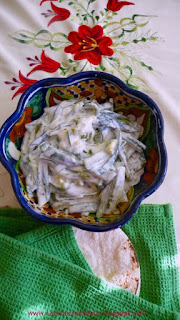 re of a hot chile, but instead of crying and calling for the paramedics, you will be making so many yummy sounds that everybody will tell you to shut up. For once, chiles con crema will help you to fully enjoy the chile flavors you were missing out on as you were busy jumping up and down from the pain: the sweetness, the spicy yumminess, the cool-hot-mildness of chiles and crema together. Plus it will help you get people like my friend, Marta, from whom I adapted this recipe.
 re of a hot chile, but instead of crying and calling for the paramedics, you will be making so many yummy sounds that everybody will tell you to shut up. For once, chiles con crema will help you to fully enjoy the chile flavors you were missing out on as you were busy jumping up and down from the pain: the sweetness, the spicy yumminess, the cool-hot-mildness of chiles and crema together. Plus it will help you get people like my friend, Marta, from whom I adapted this recipe.
Marta is not just a fabulous cook, she is just plain fabulosa—someone I would be intensely jealous of if she wasn't so kind and loveable. I envy her perfect teeth, the way her hair shines auburn in the sunlight, how she makes people giddy and smiling like fools, myself included, when she gives them un fuerte abrazo—a big fat hug—and says, "Hi, honeeeeey! ¿Cómo estás?" But mostly, it's her fearlessness, at least where chiles are concerned, that I envy the most. And, how that beautif ul fire-eating dragon regularly takes some habanero chiles in her perfectly manicured hand and pops them in her mouth like they were little orange apples. Her salsas are so powerful that, seriously, I believe that her tongue and taste buds have been reduced to scorched earth. I am a bit of a fire breather myself, but there is no way I can compete with Marta. Actually, nobody can compete with Marta.
 ul fire-eating dragon regularly takes some habanero chiles in her perfectly manicured hand and pops them in her mouth like they were little orange apples. Her salsas are so powerful that, seriously, I believe that her tongue and taste buds have been reduced to scorched earth. I am a bit of a fire breather myself, but there is no way I can compete with Marta. Actually, nobody can compete with Marta.
Until now.
Seeing that I have no desire to torch my treasured little taste buds, I doubt that I will ever be as fabulosa as Marta. But, if eating a fierce chile with crema will miraculously make me as sweet as mi amiga, you can rest assured that I'll gobble up some habaneros with crema and will be loving every minute of it.
Chile Strips With Mexican Crema
Rajas de chiles con crema
The best way to try this dish is with some poblano chiles, mild but bursting with flavor, and some jalapeños. Although I prefer to roast my chiles in order to remove the outer skin, you can omit this step if you want. Adding some sweet onion as you are frying the chiles only makes it all the more delicious. This is so easy to make that you really don't need a recipe. Feel free to experiment with any fresh chile you have on hand, such as Anahiem, Poblano, Jalapeño,etc., depending how hot or mild you want it to be. Serve this with almost any Mexican dish, or in a taco. If you want to kick it up a notch, add a touch of hot red salsa to any mild version of this recipe before taking a bite. If you cannot find crema mexicana, no problem. Sour cream is good enough in a pinch. I like my dish super thick and tangy, so I used El Mexicano's "Crema Superior", a thick acidified sour cream instead. Any of the different varieties of Mexican crema will do. If you need to reheat this dish but the sauce has become too thick for your liking, you can always add a little bit of pourable crema or milk to thin it down a bit.
Rajas de chiles con crema
The best way to try this dish is with some poblano chiles, mild but bursting with flavor, and some jalapeños. Although I prefer to roast my chiles in order to remove the outer skin, you can omit this step if you want. Adding some sweet onion as you are frying the chiles only makes it all the more delicious. This is so easy to make that you really don't need a recipe. Feel free to experiment with any fresh chile you have on hand, such as Anahiem, Poblano, Jalapeño,etc., depending how hot or mild you want it to be. Serve this with almost any Mexican dish, or in a taco. If you want to kick it up a notch, add a touch of hot red salsa to any mild version of this recipe before taking a bite. If you cannot find crema mexicana, no problem. Sour cream is good enough in a pinch. I like my dish super thick and tangy, so I used El Mexicano's "Crema Superior", a thick acidified sour cream instead. Any of the different varieties of Mexican crema will do. If you need to reheat this dish but the sauce has become too thick for your liking, you can always add a little bit of pourable crema or milk to thin it down a bit.
Ingredients:
About 6 poblano chiles, or any chile you prefer
4 jalapeño chiles (optional)
About 1 tablespoon of vegetable oil
About 1 tablespoon butter
About 1/3 onion, sliced into strips (optional)
One jar of Mexican Crema (about 15 fl. oz); or the equivelent of sour cream or crème fraîche
Salt to taste
Directions:To lightly roast the chiles, bring a large pot of water to a rolling boil. Put the chiles in the pot, and parboil the poblanos for about 6 minutes. (Only about 4 or 5 minutes in the boiling water for the jalapeños). Remove the chiles from the pot and place them on a platter.
 Using a pair of metal tongs, take each chile and hold it over the flame of a gas burner of your stove. You will see the skin of the chiles burst almost instantly. Do the same for the jalapeños. Quickly place each chile as you are done roasting it and place it in a plastic bag, but covered very loosely. You do not want your Poblano chile to be overly cooked and soggy.
 When the chiles cool somewhat, use the back edge of a knife to scrape of the charred outer skin of each chile (see picture, above). Cut the chiles open lengthwise, and remove the seeds and stem. Do the same for the jalapenos. Now slice the chiles in long strips for the poblanos, crosswise for the jalapeños. If you like, you can slice up some onion into long strips, too.
 Over medium-low heat, melt the vegetable oil and the butter together in a medium sized saucepan. Add the chiles and the onion. When the chile and onion are soft and its aroma fills the kitchen, lower the heat and add the crema to taste. (You can always use the leftover crema for something else). Once the crema is just hot, remove from the heat and season with salt to taste. Pour into a large bowl and serve right away.
Using a pair of metal tongs, take each chile and hold it over the flame of a gas burner of your stove. You will see the skin of the chiles burst almost instantly. Do the same for the jalapeños. Quickly place each chile as you are done roasting it and place it in a plastic bag, but covered very loosely. You do not want your Poblano chile to be overly cooked and soggy. When the chiles cool somewhat, use the back edge of a knife to scrape of the charred outer skin of each chile (see picture, above). Cut the chiles open lengthwise, and remove the seeds and stem. Do the same for the jalapenos. Now slice the chiles in long strips for the poblanos, crosswise for the jalapeños. If you like, you can slice up some onion into long strips, too. Over medium-low heat, melt the vegetable oil and the butter together in a medium sized saucepan. Add the chiles and the onion. When the chile and onion are soft and its aroma fills the kitchen, lower the heat and add the crema to taste. (You can always use the leftover crema for something else). Once the crema is just hot, remove from the heat and season with salt to taste. Pour into a large bowl and serve right away. 
 Serves about 6 people.
Now you can eat chiles without fear.


.jpg)

.JPG) or Pancho Villa.
or Pancho Villa..jpg) This pasta soup is mistake proof, and this recipe is just a guide. It can be as "dry" or as "wet" as you want. If it comes out too watery for you, just boil it down to the consistency you like. Besides, the fideos will continue to soak up the moisture until they are "dry". Children love this soup, especial if you use star or alphabet pasta instead of coiled or cut fideos. My little niece goes nuts when you top the "dry" soup with Oaxacan or mozzarella cheese. Feel free to double the recipe if you want. Why the whole chile in the soup? It won't add any spiciness. But whoever ends up with the chile has to eat it!
This pasta soup is mistake proof, and this recipe is just a guide. It can be as "dry" or as "wet" as you want. If it comes out too watery for you, just boil it down to the consistency you like. Besides, the fideos will continue to soak up the moisture until they are "dry". Children love this soup, especial if you use star or alphabet pasta instead of coiled or cut fideos. My little niece goes nuts when you top the "dry" soup with Oaxacan or mozzarella cheese. Feel free to double the recipe if you want. Why the whole chile in the soup? It won't add any spiciness. But whoever ends up with the chile has to eat it!.JPG)
.JPG)
.JPG)
.JPG)
.JPG)
.JPG)
.JPG)


.JPG)
.JPG)
